

You twisted your ankle days or even weeks ago. The severe pain has reduced, and you may be walking again but your ankle is still swollen.
Is that normal?
In many cases, some swelling after an ankle sprain can last longer than people expect. A soft-tissue ankle injury commonly takes around six weeks to heal, while mild discomfort or swelling can sometimes continue for several months.
What matters is not just whether swelling is present but whether your ankle is gradually improving.
Quick Answer: How Long Can Ankle Swelling Last?
After a significant ankle sprain, swelling is usually worse during the early stages and gradually decreases.
Most sprains start feeling better within the first couple of weeks. However, more significant injuries may take 6–8 weeks or longer for symptoms to settle, and some residual swelling can remain for 3–6 months.
So an ankle that is still slightly swollen after two or four weeks is not automatically a sign that something is wrong.
The more important question is: Are pain, movement and walking ability improving?
Why Is My Ankle Still Swollen?
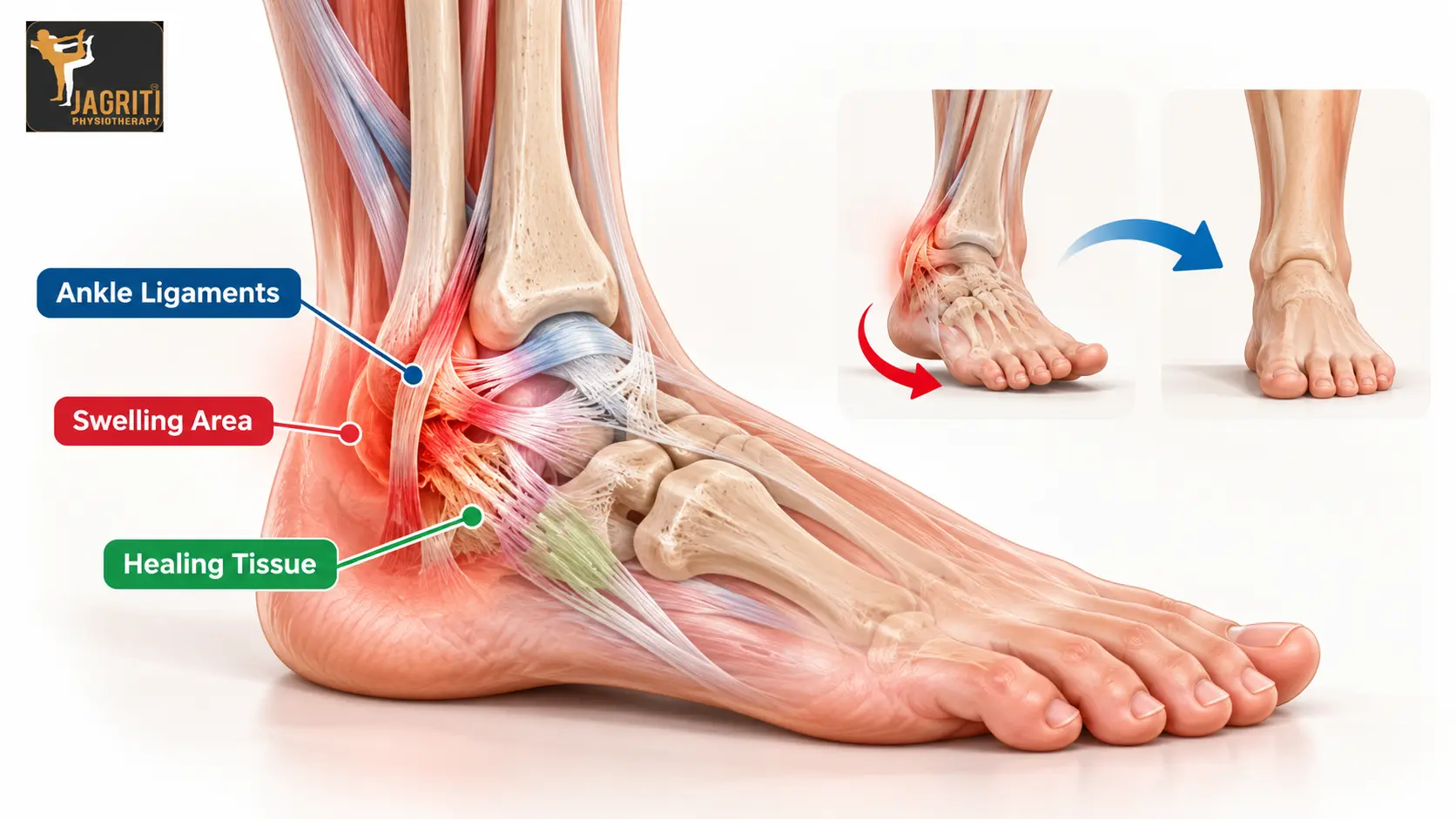
An ankle sprain happens when the ligaments supporting the ankle are stretched or torn after the foot twists beyond its normal range.
This injury can cause:
- swelling
- bruising
- pain
- stiffness
- weakness
- difficulty walking normally
Swelling is part of the body’s response to soft-tissue injury. More severe ligament injuries generally produce more swelling and can take longer to recover.
Your ankle may also swell more after standing or walking because activity places greater demand on the recovering tissues.
Is Swelling After 1–2 Weeks Normal?
Some swelling during the first couple of weeks can be expected, especially after a moderate ankle sprain.
At this stage, the ankle may feel reasonably comfortable in the morning but become more swollen after:
- walking for long periods
- standing at work
- using stairs repeatedly
- returning to exercise too quickly
- spending several hours with the foot down
Bruising can also remain visible for two to three weeks after some soft-tissue ankle injuries.
What you should generally notice is a gradual improvement rather than increasing pain and swelling.
Is All Outer Elbow Pain Tennis Elbow?
Mild residual swelling can still occur after four to six weeks.
University Hospitals Sussex advises that some discomfort and swelling may continue for 3–6 months after an ankle sprain. However, if you still have significant pain and swelling after six weeks, further assessment is recommended.
You should also pay attention to function.
Can you:
- walk without a significant limp?
- move the ankle more comfortably?
- stand on the affected leg?
- manage stairs?
- return gradually to daily activity?
Persistent swelling combined with poor function deserves more attention than mild swelling alone.
Why Does My Ankle Swell More at the End of the Day?
This is a common pattern during recovery.
When you spend several hours standing or walking, fluid can accumulate around the healing ankle. NHS hospital guidance notes that swelling following soft-tissue ankle injury is often worse toward the end of the day. Elevating the foot can help manage this.
If the swelling reduces after rest or elevation and the overall condition is improving week by week, this is generally more reassuring than swelling that keeps increasing.
What Can You Do About Persistent Swelling?
During the first few days after a sprain, protection, relative rest, ice, compression and elevation are commonly used to help manage symptoms.
As the initial pain settles, recovery should gradually shift toward restoring normal movement and activity.
Helpful steps may include:
- elevating the ankle after prolonged activity
- wearing supportive, comfortable footwear
- avoiding sudden increases in walking or exercise
- gradually restoring ankle movement
- progressively strengthening the lower leg and ankle
- rebuilding balance and stability
Complete rest for several weeks is usually not the goal. Gentle movement should gradually return as pain allows.
When Should You Start Ankle Exercises?

Once the acute pain and swelling have started settling, gentle movement can usually be introduced gradually.
Early exercises may involve:
- ankle up-and-down movements
- gentle ankle circles
- calf stretching
- controlled weight-bearing
Later rehabilitation may include:
- calf raises
- resistance exercises
- single-leg balance
- step exercises
- sport-specific movement
Progress should depend on symptoms and function rather than simply the number of days since the injury.
For a complete early ankle-sprain guide, read our existing article on sprained ankle recovery.
Why Strength and Balance Matter
Feeling less pain does not always mean the ankle has fully recovered.
After a sprain, some people continue to experience reduced strength, balance or confidence in the injured ankle.
This can become noticeable while:
- walking on uneven ground
- changing direction quickly
- running
- jumping
- playing sport
More significant sprains may benefit from physiotherapy to restore joint movement, muscular strength and ankle stability.
When Should You Worry About Ankle Swelling?
Seek medical assessment if:
- swelling is getting worse instead of better
- pain is severe or increasing
- you cannot bear weight or walk normally
- your ankle looks deformed
- you heard a crack, snap or grinding sound during the injury
- your foot becomes numb or develops altered sensation
- the area becomes unusually hot or red
- significant pain and swelling remain after several weeks
Severe pain, deformity, inability to walk, or worsening swelling can sometimes indicate a fracture or another injury that needs medical assessment.
How Can Physiotherapy Help?
If your ankle is improving slowly or still feels weak, stiff or unstable, physiotherapy can assess more than just the swelling.
A physiotherapist may check:
- ankle range of motion
- ligament-related symptoms
- calf strength
- ankle strength
- balance
- walking pattern
- single-leg control
- readiness to return to sport
Rehabilitation can then progress from comfortable movement to strength, balance and functional exercises.
At Jagriti Physiotherapy in Jaipur, orthopedic and sports rehabilitation includes personalised assessment and rehabilitation for ligament and musculoskeletal injuries.
Final Takeaway
An ankle that remains slightly swollen several weeks after a sprain is not necessarily failing to heal.
Recovery depends on how severe the original injury was, how much activity the ankle is handling, and whether strength, mobility and stability are returning.
Focus on the overall trend: pain should reduce, walking should become easier, movement should improve and swelling should gradually settle.
If the ankle remains significantly painful, swollen, weak or unstable—or your progress has stopped—a professional assessment can help determine why recovery is taking longer.
Frequently Asked Questions
1. Is ankle swelling after two weeks normal?
Ans: Some swelling can still be present after two weeks, especially after a more significant sprain. It should generally be improving rather than getting progressively worse.
2. Can an ankle still be swollen after one month?
Ans: Yes. Mild swelling can remain for several weeks and sometimes longer after soft-tissue ankle injuries.
3. Should I keep using ice after several weeks?
Ans: Ice is mainly used during the early stage to help manage symptoms. Later rehabilitation generally focuses more on comfortable movement, progressive loading and managing activity.
4. Why does my ankle swell after walking?
Ans: A recovering ankle may become more swollen after prolonged standing or walking. Reducing excessive activity temporarily and elevating the foot afterward may help.
5. When should I see a physiotherapist?
Ans: Consider assessment if swelling and pain are not gradually improving, your ankle feels unstable or stiff, you are still limping, or you are struggling to return to normal activities.
About the Author

Dr Deepesh nainani
Dr. Deepesh Nainani (PT) is a leading physiotherapist in Jaipur, offering expert, patient-focused care. He leads Jagriti Physiotherapy with a skilled team across multiple specialties. Known for his achievements and modern treatment approach, he ensures effective recovery and long-term results, making him a trusted choice for physiotherapy in Jaipur.
Get Quote Now

