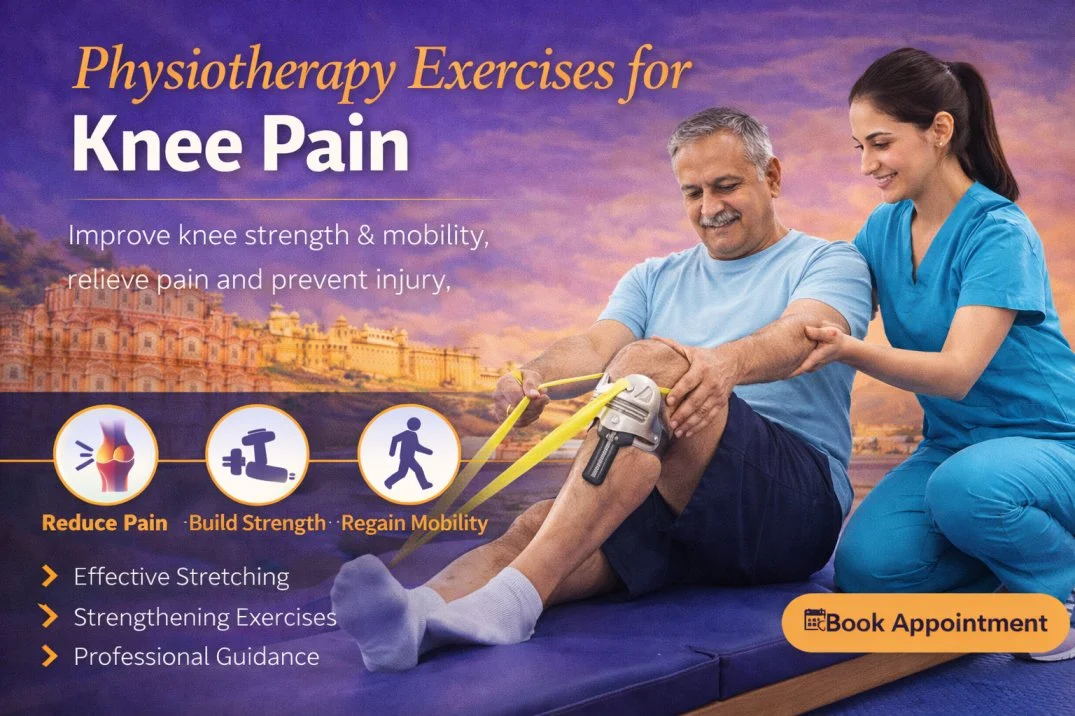
There is a very common instinct when the knee starts hurting — rest it completely and wait for the pain to pass. And to be fair, that approach works for the odd sore day. But when knee pain keeps coming back, or when it has been quietly getting worse over weeks and months, rest alone is not the answer. In fact, for most people with knee pain, too much rest makes things worse.
Movement — the right kind, done the right way — is genuinely one of the most effective treatments for knee pain. This is not just a physiotherapy opinion. It is backed by consistent evidence across all the major causes of knee pain: osteoarthritis, ligament injuries, patellofemoral syndrome, and general knee weakness.
The challenge is knowing which exercises actually help, which ones are safe to do at home, and which ones you should be avoiding entirely. If you are in Jaipur and dealing with knee pain — whether it is from a recent injury, years of wear, or something in between — this guide is built for you and supported by our specialized knee physiotherapy services.
Why Exercise is the Best Treatment for Knee Pain
Most people find this counterintuitive. The knee hurts — why would you put more load on it?
Here is the logic. The knee joint does not work in isolation. It is supported by a group of muscles — primarily the quadriceps at the front, the hamstrings at the back, and the glutes and hip muscles above — that share the load every time you move. When these muscles are strong, the knee joint itself takes less direct stress. When they are weak, the joint takes more than it should, which accelerates wear, increases pain, and makes recovery slower.
Research in knee osteoarthritis has shown that patients with the condition lose anywhere between 25% to 45% of their knee extension strength compared to healthy individuals their age. That weakness is not just a side effect of knee pain — it is one of the main reasons the pain keeps getting worse. Strengthening those muscles does not just reduce pain during exercise. It reduces pain all day, every day, because the joint is being better protected with every step.
Beyond muscle strength, regular targeted exercise improves joint lubrication, reduces stiffness, helps manage body weight, and trains the neuromuscular system — the coordination between muscles and the brain — to protect the knee during daily movement.
The bottom line: for most people with knee pain, the single most effective long-term intervention is a well-designed exercise programme. Not painkillers. Not injections. Exercise.
Also Read: Complete Guide To Knee Pain & Physiotherapy Treatment in Jaipur
Before You Start — Important Safety Tips
A few things to keep in mind before you start any of the exercises below.
Pain is a signal, not a challenge to push through
Mild discomfort during exercise — a 3 or 4 out of 10 — is generally acceptable and expected when you are working a weak or painful knee. Sharp pain, sudden worsening, or significant swelling after exercise is your body telling you to stop and get assessed.
Start where you are, not where you think you should be
The exercises in this guide are designed to be accessible, but everyone starts at a different point. If even the gentlest exercise causes significant pain, that is important information — it means you need an assessment before proceeding independently.
Consistency matters more than intensity
Doing gentle knee strengthening exercises at home every day will always beat doing a heavy session twice a week. The knee responds to regularity.
Warm up first
A 5-minute walk or gentle stationary cycling before exercises reduces joint stiffness and prepares the muscles. Going straight into exercises on a cold, stiff knee is a quick way to flare up symptoms.
If you are not sure, get assessed first
This guide is general. Your knee is specific. The exercises that are appropriate for someone with early osteoarthritis may be different from what is right for someone recovering from a ligament injury. If in doubt, book a consultation at Jagriti Physiotherapy before starting — it saves a lot of frustration later.
Strengthening Exercises for Knee Pain
These are the core of any knee rehabilitation programme. They are designed to be done at home, without gym equipment, and are safe for most people with knee pain when performed correctly.
Quadriceps Strengthening
The quadriceps is the most important muscle group for knee health. Strengthening it is non-negotiable for anyone with knee pain.
- Quadriceps sets (isometric quad contraction) The simplest quad exercise — and the safest one to start with. Sit or lie on the floor with your leg straight. Tighten the muscle on the front of your thigh by pressing the back of your knee gently into the floor. Hold for 5 seconds, release, and repeat. Do 3 sets of 15 repetitions on each leg. You should feel the muscle switch on without any joint movement or pain.
- Straight leg raises Lie flat on your back. Bend one knee with the foot flat on the floor, and keep the other leg straight. Tighten the quad of the straight leg and lift it to the height of the bent knee. Hold for 2 seconds, then lower slowly. Do 3 sets of 12 to 15 repetitions per leg. This builds quad strength without putting any load through the knee joint — making it ideal in early rehabilitation or for patients with significant joint pain.
- Mini squats (partial squats) Stand with your feet hip-width apart, holding a chair or wall for balance if needed. Slowly bend your knees to about 30 to 45 degrees — not a full squat, just a gentle dip. Hold for 2 to 3 seconds, then straighten. Do 3 sets of 10 to 12 repetitions. Keep your knees tracking over your toes and your weight through your heels. This exercise strengthens the quads and glutes together in a functional position.
- Wall sits Stand with your back against a wall. Slowly slide down until your knees are at about 45 to 60 degrees of bend — not a full 90 degrees. Hold the position for 20 to 30 seconds and slide back up. Repeat 5 times. Wall sits build quad endurance — the ability to sustain effort, which is what you need for walking and standing through a long day.
Hamstring Strengthening
The hamstrings work in balance with the quadriceps to protect and stabilise the knee. Research shows that people with knee pain often have significant hamstring weakness alongside their quad weakness — and addressing both gives much better results than quad work alone.
- Standing hamstring curls Stand holding a chair or wall for balance. Slowly bend one knee, bringing your heel towards your buttocks. Hold for 3 seconds at the top and lower slowly. Do 3 sets of 12 repetitions on each leg. Focus on slow, controlled movement rather than swinging the leg up quickly.
- Prone hip extension Lie face down on the floor with legs straight. Tighten your glute and lift one leg about 10 to 15 centimetres off the floor. Hold for 3 seconds, lower slowly, and repeat. Do 3 sets of 10 to 12 per leg. This works both the hamstrings and glutes simultaneously and is very joint-friendly.
- Hamstring stretch (lying) Lie on your back. Loop a towel or dupatta around the sole of one foot and gently straighten the leg, pulling it toward you until you feel a stretch along the back of the thigh. Hold for 30 seconds. Repeat 3 times on each side. Tight hamstrings pull on the back of the knee and contribute significantly to pain — regular stretching of this muscle is as important as strengthening it.
Glute and Hip Strengthening
This is where a lot of people are surprised. The hip and glute muscles are far up from the knee — so why do they matter?
Because weak hips cause the thigh bone to rotate inward during movement, which directly increases the stress on the knee joint. It is a mechanical chain — what happens at the hip affects the knee with every step. Research consistently shows that hip strengthening reduces knee pain, particularly in conditions like patellofemoral syndrome and IT band-related knee pain.
- Glute bridges Lie on your back with both knees bent and feet flat on the floor. Push through your heels and lift your hips toward the ceiling, squeezing your glutes at the top. Hold for 3 to 5 seconds and lower slowly. Do 3 sets of 15 repetitions. This is one of the single best exercises for people with knee pain — strong evidence, very low joint stress, and a muscle group most people have significantly neglected.
- Clamshells Lie on your side with your hips and knees bent to about 45 degrees, feet together. Keeping your feet touching, rotate your top knee upward like a clamshell opening. Hold at the top for 2 seconds and lower slowly. Do 3 sets of 15 per side. This targets the gluteus medius — the hip muscle most responsible for keeping the knee aligned during walking and standing.
- Side-lying hip abduction Lie on your side with your body in a straight line. Lift the top leg to about 30 to 40 degrees, hold for 2 seconds, and lower slowly. Do 3 sets of 15 per side. This exercise is beginner-friendly and very effective for waking up the hip abductors.
Stretching and Flexibility Exercises
Tight muscles around the knee contribute significantly to pain. The quadriceps, hamstrings, calf, and IT band (along the outer thigh) all pull on the knee when they are tight — increasing joint stress and reducing range of motion. Regular stretching is not optional — it is part of the treatment.
- Quadriceps stretch (standing) Stand near a wall for balance. Bend one knee and bring the heel towards your buttock, holding the ankle with your hand. Keep your knees together and stand tall — do not lean forward. Hold for 30 seconds, 3 times per side. You should feel the stretch along the front of the thigh.
- Calf stretch (wall stretch) Stand facing a wall. Place one foot behind you with the heel flat on the floor and the knee straight. Lean into the wall gently until you feel a stretch in the back of the lower leg. Hold for 30 seconds, 3 times per side. Tight calves increase load on the knee during walking — this stretch is particularly important for patients with front-of-knee pain.
- IT band stretch Stand with your right leg crossed behind your left. Lean your upper body to the left, reaching your right arm overhead. You should feel a stretch along the outer right thigh and hip. Hold for 30 seconds, 3 times per side. Tight IT band is one of the most common contributors to outer knee pain, especially in runners and cyclists.
Low-Impact Exercises Safe for Knee Pain
Outside of the specific rehabilitation exercises above, staying generally active is important for knee health. These activities are safe and beneficial for most people with knee pain:
Walking
Short, regular walks on flat ground are excellent. Start with 10 to 15 minutes and build gradually. Avoid uneven terrain or prolonged walking on hard surfaces until strength has improved.
Stationary cycling
One of the best low-impact exercises for the knee. It builds quad and hamstring strength, improves joint mobility, and does not put compressive load through the joint the way walking on hard surfaces can. If you have a cycle at home, even 10 to 15 minutes a day makes a difference.
Swimming
The water takes your body weight almost completely off the joints. Swimming and water walking are particularly good for patients with significant knee OA or those who are overweight.
Yoga (modified)
Gentle yoga with modifications for knee sensitivity can improve flexibility, hip strength, and body awareness. Avoid deep knee bends, hero pose, or any position that forces the knee into extreme flexion without supervision.
Exercises to Avoid With Knee Pain
Just as important as knowing what helps is knowing what makes things worse.
Deep squats
Bending the knee past 90 degrees puts enormous compressive force on the cartilage and meniscus. For patients with osteoarthritis, patellofemoral pain syndrome, or a recent injury, deep squats should be avoided until cleared by a physiotherapist.
Full leg extensions on a machine
The seated leg extension machine at the gym isolates the quad under heavy load at a position that creates significant shear force on the knee joint. It is consistently listed among the worst exercises for painful knees.
Running on hard surfaces without preparation
Running is not automatically bad for the knee — but running on hard surfaces with weak muscles and no preparation is. It becomes a problem particularly when someone jumps back into running after a period of pain or inactivity.
High-impact jumping exercises (burpees, jump squats, box jumps)
These put multiple times your body weight through the knee with each landing. Without strong supporting muscles and proper technique, these are high-risk exercises for any patient with existing knee pain.
Sitting cross-legged on the floor for long periods
This is something many Jaipur patients do daily — for meals, prayers, family time. Prolonged cross-legged sitting puts sustained stress on the inner compartment of the knee and can significantly worsen OA and meniscal symptoms. Try to use a low chair or cushion instead.
Prolonged squatting (Indian-style toilet use, floor-level work)
Deep, sustained squatting puts extreme load on the knee. If this is unavoidable in daily life, building hip and quad strength over time will help. In the short term, modifications and assistive devices are worth considering.
When Home Exercises Are Not Enough
Home exercises are powerful — but they have limits.
If your knee pain has been present for more than 3 to 4 weeks despite consistent exercise, if the pain is worsening rather than improving, if you have significant swelling or any locking or giving way of the knee, or if you are just not sure what you are dealing with — it is time to see a physiotherapist.
There are also cases where doing the wrong exercise for the wrong diagnosis can make things worse. A patient with a bucket handle meniscus tear, for example, needs very different management from someone with early-stage osteoarthritis. Getting an assessment first means the exercise programme you follow is the right one for your specific knee — not a generic routine from the internet.
Get a Personalised Exercise Plan — Online or in Clinic
The exercises in this guide are a starting point — a good one. But the best results always come from a programme that is built around your specific condition, your current strength levels, and your daily demands.
At Jagriti Physiotherapy in Shyam Nagar, Sodala, Jaipur, Dr. Deepesh Nainani provides thorough knee assessments and builds individualised physiotherapy exercise programmes for patients across all conditions and stages of recovery. Whether you are dealing with early-stage osteoarthritis, recovering from an injury, or simply trying to get on top of knee pain that keeps coming back — the right programme makes an enormous difference to how quickly and fully you recover.
Can not make it to the clinic? Online consultations are available for patients across Jaipur and beyond. Dr. Deepesh Nainani will assess your knee through a guided video consultation and provide a structured home exercise programme — with follow-up sessions to track your progress and make adjustments as you improve.
FAQs — Knee Pain Exercises
1. What are the best physiotherapy exercises for knee pain at home?
Ans: The most effective home exercises for knee pain are quadriceps sets, straight leg raises, mini squats, glute bridges, clamshells, and hamstring curls. These target the key muscle groups that support and protect the knee joint — all without any gym equipment. Stretching the quadriceps, hamstrings, and calves regularly is equally important.
2. How often should I do knee strengthening exercises?
Ans: For best results, aim for daily or at least 5 days a week. The knee responds to consistency more than intensity. Even 20 to 30 minutes a day of targeted strengthening and stretching, done regularly, will produce meaningful improvement within a few weeks.
3. Can exercise make knee pain worse?
Ans: Done incorrectly or without appropriate guidance, yes — it can. Sharp pain, significant swelling after exercise, or pain that is worse the following day are all signs that the exercise is not right for your current condition. Mild discomfort during exercise is normal. Severe or worsening pain is not.
4. What exercises should I avoid with knee pain?
Ans: Avoid deep squats, full leg extensions on a machine, high-impact jumping exercises, running on hard surfaces without preparation, and prolonged sitting cross-legged on the floor. These activities put excessive stress on the knee joint, particularly when the supporting muscles are already weak.
5. Is walking good exercise for knee pain?
Ans: Generally yes — walking on flat ground at a comfortable pace is beneficial for knee health. It keeps the joint mobile, supports muscle strength, and helps with weight management. The key is to build up gradually, wear supportive footwear, and avoid pushing through sharp pain.
6. Are knee strengthening exercises different for osteoarthritis vs ligament injury?
Ans: Yes — while there is overlap, the specific exercises, the intensity, and the phase of rehabilitation differ depending on the diagnosis. Patients with ligament injuries often need more focus on neuromuscular control and stability. Osteoarthritis patients need more emphasis on load management and endurance. A physiotherapy assessment will determine what is right for you.
7. How long does it take for knee exercises to reduce pain?
Ans: Most patients notice some improvement within 4 to 6 weeks of consistent exercise. Significant functional improvement typically takes 2 to 3 months. This varies depending on how long the problem has been present and how consistently the programme is followed.
8. Can I do knee exercises if my knee is swollen?
Ans: Gentle isometric exercises like quadriceps sets and ankle pumps are generally safe even with mild swelling and can actually help reduce it by improving circulation. More demanding exercises should be avoided until swelling settles. If the swelling is significant or came on suddenly, get it assessed before exercising.
9. Do I need equipment for knee strengthening exercises at home?
Ans: No. All the exercises in this guide require no equipment at all — just a mat or carpeted floor, and a chair or wall for balance support where needed. A resistance band can be a useful addition once you are progressing, but it is not essential to start.
10. When should I see a physiotherapist instead of just doing home exercises?
Ans: If your pain has been present for more than 3 to 4 weeks without improvement, is getting worse despite exercise, involves swelling, locking, or instability, or if you are not sure what is causing it — see a physiotherapist. Home exercises are valuable but they work best when they are the right exercises for the right diagnosis.
About the Author

Dr Deepesh nainani
Dr. Deepesh Nainani (PT) is a leading physiotherapist in Jaipur, offering expert, patient-focused care. He leads Jagriti Physiotherapy with a skilled team across multiple specialties. Known for his achievements and modern treatment approach, he ensures effective recovery and long-term results, making him a trusted choice for physiotherapy in Jaipur.
Get Quote Now

