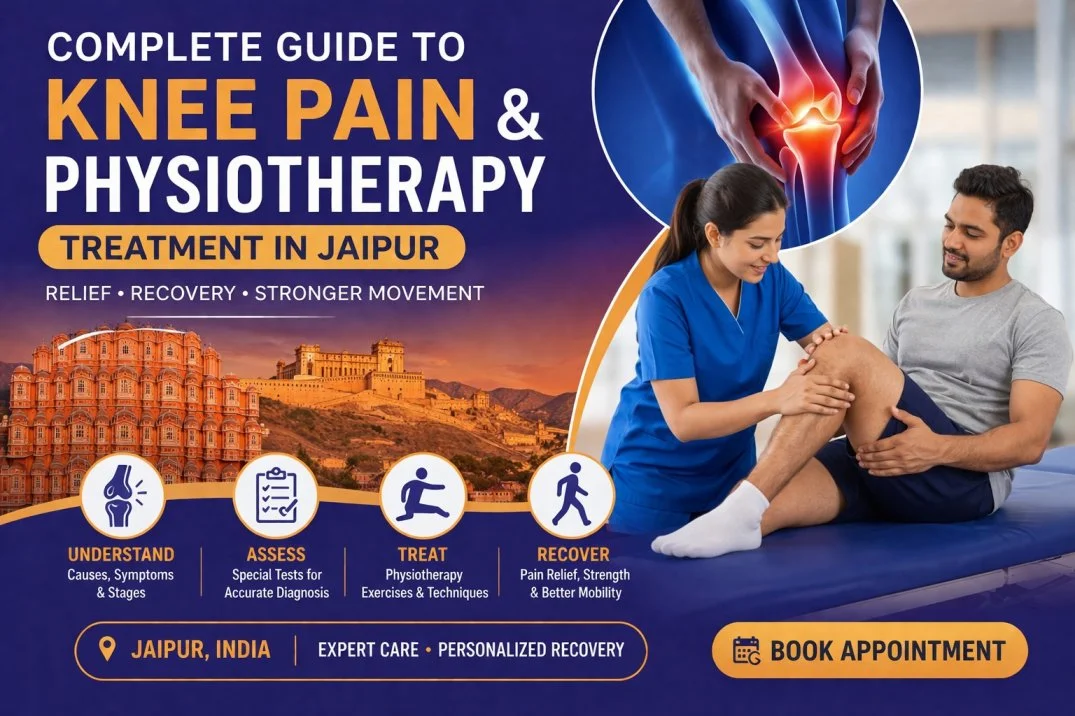
Knee pain is quietly one of the most common health complaints in India — and in Jaipur, we see it every single day. In people in their 30s. In elderly patients who have been quietly tolerating it for years. In young athletes who felt something go wrong during a game. In working professionals whose knees have started protesting after years of sitting, standing, and going up and down stairs.
The numbers are telling. India had over 62 million individuals with osteoarthritis alone by 2019 — up from around 23 million in 1990. Knee osteoarthritis accounts for the largest share of that burden. And that is just one cause of knee pain, out of many.
What most people in Jaipur do when the knee starts hurting is predictable — they rest, take a painkiller, apply a gel, and wait. For some, that works short-term. For a lot of people, the pain keeps coming back. And each time it does, it tends to be a little more persistent than the last.
This guide is written by the clinical team at Jagriti Physiotherapy in Shyam Nagar, Sodala, Jaipur. Our purpose is simple to give you a clear, honest, and medically accurate understanding of why knees hurt, what proper knee physiotherapy involves, and what can actually be done about it. No fluff, no vague reassurances. Just useful, evidence-based information written by Dr. Deepesh Nainani (PT), who treats complex knee conditions every single week.
What Causes Knee Pain?
The knee is one of the most mechanically complex joints in the body. It bears enormous load — when you walk on flat ground, the force through the knee is roughly 1.5 times your body weight. On stairs, that rises to 3 to 4 times. During a squat or a deep sit-down, it can go even higher. Over years and decades, that load adds up.
Knee pain rarely has a single, simple cause. In most patients, it develops from a combination of factors — some structural, some muscular, some related to lifestyle habits that have quietly accumulated over time.
The most common contributors we see in Jaipur include:
Age-related wear and tear
The gradual breakdown of cartilage that comes with aging, particularly after 45. It is more common in women and strongly associated with previous injury history.
Muscle weakness
Particularly the quadriceps and hip muscles. When these muscles are weak, the knee joint absorbs load it was never designed to take alone. This is a factor in virtually every knee condition we treat.
Old injuries that were never properly rehabilitated
A minor ligament sprain, a neglected meniscus micro-tear, or an old fracture that was rested but never fully rehabilitated. These often resurface years later as chronic joint pain.
Lifestyle habits
Prolonged sitting cross-legged, repeated deep squatting, long hours on the feet on hard flooring, and excess body weight all place sustained, repetitive stress on the knee structures over time.
Overuse and sudden increase in activity
Starting a new running programme, joining a gym, or increasing training volume faster than the body can adapt. This is a very common driver of knee pain in Jaipur’s growing fitness community.
Poor footwear and foot mechanics
Flat feet, excessive pronation, and unsupportive footwear all alter the forces travelling through the knee with every step.
Understanding the cause of your specific knee pain matters — because the treatment that works for osteoarthritis is different from what works for a knee ligament injury rehabilitation, which is different again from what works for runner’s knee. Correct diagnosis comes before correct treatment. Always.
Common Knee Conditions Treated With Physiotherapy
Physiotherapy is effective for a wide range of knee conditions. Here is an overview of the most common ones we treat at Jagriti Physiotherapy — each with a link to the full detailed guide on that condition.
Knee Osteoarthritis
Knee osteoarthritis is the single most common cause of chronic knee pain in India, particularly in adults over 45. It is a degenerative condition where the cartilage inside the knee joint gradually breaks down, causing pain, stiffness, swelling, and progressive loss of movement.
Many patients believe an OA diagnosis means surgery is inevitable. It is not. International clinical guidelines list structured physiotherapy as the first-line treatment for knee osteoarthritis. For Grade 1, Grade 2, and many Grade 3 cases, a targeted program of targeted strengthening and manual therapy significantly reduces pain and can delay or completely eliminate the need for a total knee replacement (TKR).
- Key symptoms: morning stiffness lasting less than 30 minutes, pain that worsens with activity and settles with rest, swelling, a cracking sensation in the joint, and increasing difficulty with stairs and floor-level activities.
Ligament Injuries — ACL, PCL, MCL
The knee has four major ligaments that act as stabilising cables, controlling how the joint moves and protecting it from excessive force. The ACL (anterior cruciate ligament) is the most commonly injured — typically during sports involving sudden direction changes, jumping, or contact. PCL and MCL injuries are less common but still significant.
Ligament injuries are graded 1 to 3 based on severity. Many Grade 1 and Grade 2 tears — and even some Grade 3 tears in less active patients — heal very well with physiotherapy alone. Even when surgery is needed, physiotherapy is essential both before the operation (to prepare the joint) and after (to actually restore function).
- Key symptoms: a popping sound at the time of injury, rapid swelling, instability or a feeling of the knee giving way, and difficulty fully bending or straightening the knee.
Meniscus Tear
The meniscus is a C-shaped cartilage structure that sits between the thigh bone and shin bone, acting as a shock absorber and stabiliser. Meniscus tears happen in two main groups — younger patients through sudden twisting injuries, and older adults through gradual degenerative wear.
Whether a meniscus tear requires surgical trimming or repair depends entirely on the tear pattern and its location. Tears located in the outer “red zone” have a rich blood supply and heal well with conservative physical therapy. Even complex tears that cannot structurally knit back together often become completely symptom-free once the surrounding musculature is sufficiently strengthened.
- Key symptoms: A meniscus tear include pain along the inner or outer joint line, swelling, a catching or locking sensation, and pain with twisting or deep squatting.
Patellofemoral Pain Syndrome
Patellofemoral pain syndrome (PFPS) commonly called runner’s knee, is pain at the front of the knee, around or behind the kneecap. It develops when the kneecap does not track correctly in its groove, usually because of muscle imbalances in the quadriceps and hip muscles.
PFPS affects around 22.7% of the population and is particularly common in runners, gym-goers, cyclists, and young athletes. It also affects people who sit for long periods — the knee bent position compresses the patellofemoral joint, which is why desk workers and frequent commuters in Jaipur often notice front-of-knee pain after long sitting sessions.
- Key symptoms: dull aching pain around the kneecap, pain that worsens going downstairs, squatting, running, and sitting for extended periods with the knee bent.
Post Knee Replacement Recovery
For patients who have had a total or partial knee replacement, physiotherapy is not optional — it is the difference between a surgery that works and one that does not deliver the results it should. The surgery replaces the damaged joint. Physiotherapy is what restores the movement, strength, and functional ability to actually use it.
Without structured post-knee replacement rehabilitation, patients are at significant risk of persistent stiffness, muscle weakness, poor walking pattern, and long-term functional limitations — even after a technically successful surgery.
Recovery after total knee replacement typically takes 3 to 6 months of structured physiotherapy, with strength improvements continuing up to 12 months. Partial knee replacement patients generally progress faster.
Symptoms That Indicate You Need a Knee Physiotherapist
A lot of people wait far too long before seeking help with knee pain. Partly because it does not feel serious enough to warrant a visit. Partly because they hope it will just go away. And partly because there is a widespread assumption that knee pain is just part of getting older — something to be managed, not treated.
None of that is true. Here is when you should stop waiting and book an assessment:
- Pain that has been present for more than 2 to 3 weeks without clear improvement, even with rest.
- Swelling around the knee — either sudden and significant, or gradual and recurring. Swelling always indicates something worth investigating.
- A popping, catching, or locking sensation — these are signs of structural involvement (meniscus or ligament) that need proper assessment, not just rest.
- Instability — the feeling that the knee might give way, or that it buckles occasionally during walking or weight-bearing.
- Pain that is affecting your daily life — avoiding stairs, changing the way you walk, giving up activities you normally do, losing sleep because of knee pain at night. These are not minor inconveniences. They are signs the problem needs treatment.
- Morning stiffness that takes more than a few minutes to wear off, particularly if accompanied by swelling or warmth.
- Pain after a specific injury — a twist, a fall, a sporting collision. Even if you can walk on it, a proper assessment rules out significant structural damage before it becomes a bigger problem.
The earlier you come in, the simpler and shorter the treatment tends to be. Most of the patients we see who have been struggling for years would have had a much easier recovery if they had come in months earlier.
How Physiotherapy Treats Knee Pain — Our Approach at Jagriti Physiotherapy
At Jagriti Physiotherapy in Jaipur, treatment always begins with a proper assessment — not a generic protocol applied before we understand what we are actually dealing with. The assessment covers range of motion, joint alignment, muscle strength, ligament stability, walking pattern, and the full history of when, how, and why the pain started.
From there, the treatment plan is built around your specific condition and your specific life. A 68-year-old with Grade 3 knee OA who wants to walk comfortably to the mandir needs a different programme than a 24-year-old cricketer recovering from an ACL tear.
Our treatment typically combines several approaches:
Manual therapy
Hands-on joint mobilisation and soft tissue techniques to reduce stiffness, improve joint mechanics, and ease pain. Many patients feel meaningful relief after just the first couple of sessions.
Exercise therapy
The backbone of all knee rehabilitation. Structured, progressive strengthening of the quadriceps, hamstrings, glutes, and hip muscles — building the muscular support that the damaged or degenerated joint needs. The research is clear: exercise is the most effective long-term treatment for knee pain across virtually all diagnoses.
Electrotherapy
Ultrasound, TENS, and interferential current for pain and swelling management, particularly in the early and acute stages. Used as a support to exercise, not a replacement for it.
Gait and movement correction
Correcting walking patterns, sitting habits, and movement mechanics that are contributing to the problem. A surprising amount of knee pain is perpetuated by how people move, not just by the structural damage itself.
Education and self-management
Teaching patients what they can safely do, what to avoid, how to progress their home exercises, and how to manage flare-ups. Our goal is always to make you less dependent on the clinic over time, not more.
Best Physiotherapy Exercises for Knee Pain
Exercise is the cornerstone of knee pain management — but the key word is the right exercise for the right diagnosis at the right stage of recovery.
That said, some exercises have strong evidence and broad applicability across most knee conditions:
- Quadriceps sets and straight leg raises — gentle quad activation and strengthening without loading the joint. Appropriate for almost everyone with knee pain, including early post-surgical patients.
- Mini squats (partial squats) — building functional quad and glute strength without the joint stress of deep squatting. A 30 to 45 degree knee bend is the sweet spot for most patients.
- Glute bridges — One of the most evidence-backed physiotherapy exercises for knee pain. Strong glutes reduce the load on the knee joint with every step.
- Clamshells and hip abduction — targeting the hip stabilisers that control knee alignment during movement. Weak hips are a factor in almost every knee condition we treat.
- Hamstring curls and stretches — the hamstrings work in balance with the quads to protect the knee. Strengthening and stretching them in combination gives much better results than quad work alone.
The exercises to avoid are equally important — deep squats, full leg extensions on a machine, high-impact jumping, and prolonged cross-legged sitting all place excessive stress on an already compromised joint.
How Long Does Knee Physiotherapy Take?
This is probably the most common question we get — and the honest answer is that it depends on several things.
The condition
Mild patellofemoral pain syndrome in a young, otherwise healthy patient can show significant improvement in 4 to 6 weeks. Moderate knee osteoarthritis typically takes 3 to 4 months for meaningful functional improvement. Post ACL surgery rehabilitation takes 9 to 12 months to return to competitive sport. Post knee replacement rehabilitation takes 3 to 6 months for most daily activities, with strength continuing to improve up to 12 months.
How long the problem has been present
A knee condition that has been building for 6 months takes longer to turn around than one that is 6 weeks old. This is one of the strongest arguments for coming in early.
Consistency with the home programme
Clinic sessions are important — but what happens between sessions matters just as much. Patients who do their home exercises consistently progress significantly faster than those who do not.
Age and overall health
Both influence the rate of tissue recovery and adaptation to exercise. They do not determine whether improvement happens — they influence the pace.
As a general guide: most patients start noticing meaningful improvement within the first 4 to 8 sessions when the treatment plan is right. Significant functional recovery follows over weeks to months depending on the diagnosis.
Online Knee Physiotherapy — Consult From Home
Jagriti Physiotherapy offers online video consultations for knee pain patients across Jaipur and beyond — for those who cannot travel to the clinic regularly, or who want an expert assessment from home.
During an online consultation, Dr. Deepesh Nainani will review your symptoms and any available investigation reports, assess your movement and strength through a guided video evaluation, and build a structured home-based physiotherapy programme tailored to your condition. Follow-up sessions track progress and adjust the plan as you improve.
Online physiotherapy works particularly well for patients in the intermediate and later stages of rehabilitation, for early-stage osteoarthritis and PFPS, and for post-surgical patients who are progressing well and managing their programme at home.
For patients in the Jaipur area, in-person sessions are always recommended in the early stages of rehabilitation — hands-on treatment adds significant value that cannot be replicated through a screen. But online consultations make expert physiotherapy accessible regardless of where you are.
Why Choose Jagriti Physiotherapy in Jaipur?
There are plenty of physiotherapy clinics in Jaipur. Here is why our patients come to us and why they keep coming back.
- Location – We are located at Plot No. A-146, Ayodhya Path, Shyam Nagar, opposite Metro Pillar No. 111, Sodala — easily accessible from Shyam Nagar, Mansarovar, Vaishali Nagar, and surrounding areas.
- Individual treatment plans – No two patients get the same programme. Every assessment, every treatment plan, and every home exercise routine is built around the specific person in front of us — their condition, their strength, their lifestyle, and their goals.
- Evidence-based approach – Our treatment is grounded in current research. We do not rely on outdated techniques or overcomplicate things with unnecessary procedures. We use what works.
- Expert care under Dr. Deepesh Nainani – is a specialist physiotherapist with deep experience in knee rehabilitation across conditions — from early-stage OA to post-surgical ACL recovery to complex multi-structure injuries.
- Focus on long-term results – We are not in the business of getting patients back through the door indefinitely. Our goal is to get you better, teach you to manage your knee independently, and send you home with the tools to stay well.
- Online consultations available – For patients who cannot visit in person — whether due to distance, mobility, or schedule — expert physiotherapy is available through video consultation.
Frequently Asked Questions About Knee Pain
1. What is the most common cause of knee pain in Jaipur?
Ans: Knee osteoarthritis is by far the most common cause of chronic knee pain, particularly in adults over 45. Among younger patients, patellofemoral pain syndrome, ligament injuries from sports, and meniscus tears are the most frequent presentations. In Jaipur specifically, daily habits like sitting cross-legged, deep squatting, and walking long distances on hard surfaces are significant contributing factors across all age groups.
2. Can physiotherapy cure knee pain permanently?
Ans: Physiotherapy cannot reverse structural damage like cartilage loss — nothing currently can. But it can significantly and lastingly reduce pain, restore function, and slow or halt progression in most conditions. For many patients, properly completed physiotherapy means living a fully active life without the pain returning — particularly when the underlying muscle weaknesses and movement patterns are addressed and maintained.
3. Do I need an X-ray or MRI before seeing a physiotherapist?
Ans: Not necessarily. A skilled physiotherapist can often make a confident clinical diagnosis without imaging. If imaging would change the management plan — for example, to confirm a suspected meniscus or ligament injury — we will recommend it. But coming in without a scan is perfectly fine, and in many cases the assessment itself provides more useful information than an MRI report alone.
4. Is knee pain normal as you get older?
Ans: It is extremely common — but it is not simply an unavoidable part of ageing that must be accepted. A large proportion of age-related knee pain is driven by muscle weakness and inactivity, both of which are directly treatable. Many of our patients in their 60s and 70s are significantly less limited by knee pain after physiotherapy than they were before it.
5. How is knee physiotherapy different from just doing exercises at home?
Ans: At-home exercises have real value — but they work best when they are the right exercises for the right diagnosis, performed at the right intensity, and progressed in the right sequence. Physiotherapy adds the diagnosis, the hands-on treatment, the technique correction, the progression decisions, and the monitoring that makes exercise-based rehabilitation actually work. Generic home exercises without assessment can sometimes make things worse, particularly for structural conditions like meniscus tears or post-surgical knees.
6. Can I continue working and exercising while having physiotherapy?
Ans: In most cases, yes — with some modifications. Physiotherapy is designed to work alongside your normal life, not replace it. Your physiotherapist will advise on what to continue, what to modify, and what to avoid during treatment. The goal is to keep you as active as possible while the knee recovers.
7. What should I expect at my first physiotherapy appointment?
Ans: Your first session is primarily an assessment. Expect questions about your history, when and how the pain started, what makes it better or worse, and what your daily activity looks like. This is followed by a physical examination — movement tests, strength checks, stability assessment, and possibly a walking assessment. Treatment may begin in the same session or in the session immediately after, once the plan is established.
8. Is physiotherapy covered under health insurance in India?
Ans: Many health insurance policies in India do cover physiotherapy, though the extent of coverage varies significantly between insurers and plans. It is worth checking your specific policy. We recommend contacting your insurance provider directly to confirm coverage before beginning treatment.
9. What is the difference between physiotherapy and just resting the knee?
Ans: Rest reduces the immediate load on the knee and can help settle acute inflammation. But it does not strengthen the muscles, correct movement patterns, improve joint mechanics, or address the underlying causes of the pain. Rest treats the symptom short-term. Physiotherapy treats the cause. This is why rest-only management leads to recurring pain in the vast majority of knee conditions.
10. How do I book a consultation at Jagriti Physiotherapy in Jaipur?
Ans: You can call us directly on +91-6376059919 or +91-9829936650, send a WhatsApp message, or book through the contact form on our website at jagritiphysio.com. Both in-person consultations at our Shyam Nagar, Sodala clinic and online video consultations are available — choose whichever works best for you.
About the Author

Dr Deepesh nainani
Dr. Deepesh Nainani (PT) is a leading physiotherapist in Jaipur, offering expert, patient-focused care. He leads Jagriti Physiotherapy with a skilled team across multiple specialties. Known for his achievements and modern treatment approach, he ensures effective recovery and long-term results, making him a trusted choice for physiotherapy in Jaipur.
Get Quote Now

