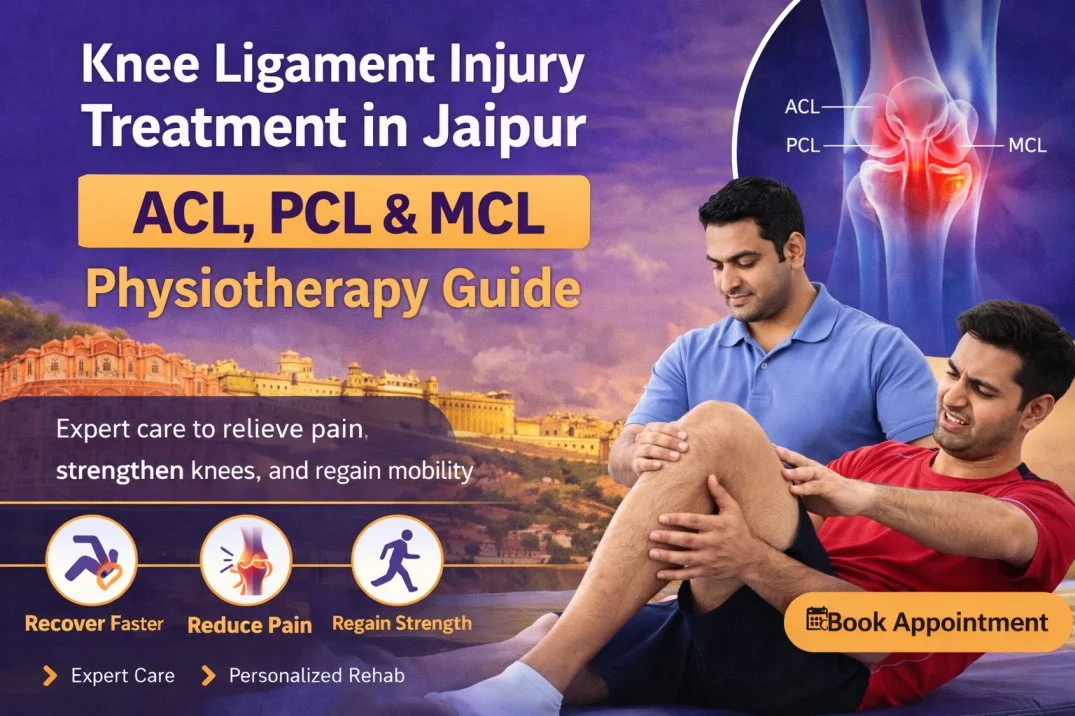
There is a very specific moment when a knee ligament tears. Most people who have been through it describe the same thing – a sudden twist, a loud pop, and then a knee that just does not feel right anymore. Sometimes the pain is intense from the start. Sometimes it is surprisingly mild. But the instability – that feeling that the knee might give way – that is hard to ignore.
Knee ligament injuries are among the most common sports injuries in India. Football, kabaddi, basketball, badminton – any sport involving sudden direction changes, jumping, or contact puts the knee ligaments under significant stress. And it is not just athletes. A bad step off the footpath, slipping on a wet floor, or an awkward landing from a height can cause the same injury in someone who has never played a sport in their life.
At Jagriti Physiotherapy in Shyam Nagar, Sodala, Jaipur, we provide specialized knee physiotherapy services and see ligament injuries regularly – both in active young patients and in older adults. This guide covers everything from what each ligament does, to how injuries are graded, to what ACL, PCL, and MCL physiotherapy actually involves.
What Are Knee Ligaments and What Do They Actually Do?
The knee is held together by four main ligaments. Think of them as strong, fibrous cables – they connect the thigh bone (femur) to the shin bone (tibia) and keep the knee moving in the right direction without going too far in any one direction.
ACL — Anterior Cruciate Ligament.
This one runs diagonally through the middle of the knee, front to back. It controls forward movement of the shin bone and rotational stability. The ACL is by far the most commonly injured knee ligament. When people say they have “done their knee,” this is usually what they mean.
PCL — Posterior Cruciate Ligament
The PCL runs just behind the ACL, crossing it inside the joint. It controls backward movement of the shin bone. PCL injuries are less common than ACL tears – they usually happen from a direct blow to the front of the knee, like hitting a dashboard in a car accident or a fall on a bent knee.
MCL — Medial Collateral Ligament
The MCL runs along the inside of the knee, connecting the femur to the tibia. It prevents the knee from buckling inward. MCL injuries are common in contact sports and often happen when a force hits the outside of the knee.
LCL — Lateral Collateral Ligament
On the outer side of the knee. Less commonly injured, but it is there. We will focus primarily on ACL, PCL, and MCL in this guide as they account for the vast majority of knee ligament injuries.
Also Read: Complete Guide to Knee Pain & Physiotherapy in Jaipur
Types of Knee Ligament Injuries — Grades 1, 2 and 3
Not all ligament injuries are complete tears. In fact, many are partial – and they respond very well to physiotherapy alone without surgery.
Ligament injuries are graded based on how much damage has occurred:
Grade 1 — Mild sprain
The ligament is stretched but not torn. There is pain and maybe minor swelling, but the joint is still stable. With proper ligament injury treatment and rest, Grade 1 injuries typically heal in 4 to 8 weeks.
Grade 2 — Partial tear
The ligament is partially torn and has loosened. There is more significant pain, swelling, and some instability. Recovery depends on which ligament is involved – an MCL Grade 2 often heals conservatively, while an ACL Grade 2 may or may not need surgery depending on the patient’s activity level and the degree of instability.
Grade 3 — Complete tear
The ligament is fully torn – essentially in two pieces. This is the most serious grade. A Grade 3 ACL tear almost always requires surgery if the patient wants to return to sport. However, even with a complete tear, non-surgical management with physiotherapy is a genuine option for less active individuals or older patients who do not participate in high-demand activities.
ACL Tear Symptoms — What Does it Feel and Look Like?
ACL tear symptoms are usually hard to miss at the moment of injury – though not always. Here is what typically happens:
The pop
Most people hear or feel a distinct popping sensation in the knee at the moment of injury. Not everyone gets this, but it is very characteristic of an ACL tear.
Immediate swelling
The knee swells up rapidly – often within a few hours. This is because the ACL has its own blood supply, and a tear causes bleeding inside the joint.
Pain
Can range from severe to surprisingly manageable. Some patients are shocked that they can still walk after an ACL tear. Do not let this fool you – walking does not mean the injury is minor.
Instability
The knee feels like it might give way, especially when turning, pivoting, or walking on uneven ground. This is the most telling sign of a significant ACL injury.
Loss of full movement
Bending or straightening the knee fully becomes difficult and painful, especially in the first few days.
PCL injury symptoms are similar but tend to present with more pain at the back of the knee, particularly when going down stairs or when the knee is bent under load.
MCL injury symptoms are usually pain and tenderness along the inner side of the knee, with swelling and discomfort when the knee is pushed inward.
How Do You Know Which Ligament is Injured?
Honestly – you cannot self-diagnose this reliably. The symptoms overlap, multiple ligaments can be injured at the same time, and other structures like the meniscus injuries are often involved too. Research shows that roughly 42% of ACL injuries also involve a meniscal tear.
What you need is a clinical assessment by a physiotherapist or orthopaedic doctor. Special physical tests – like the Lachman’s test for the ACL or the valgus stress test for the MCL – can give a fairly accurate picture even before imaging. An MRI is the gold standard for confirming which ligaments are involved and how severely.
If you have had a knee injury in Jaipur and are not sure what you have done, come in for an assessment first. Guessing and resting without proper guidance often leads to delayed treatment and a worse outcome.
ACL Injury — Surgery vs Physiotherapy
This is the question we get asked the most. And the answer genuinely depends on the individual.
Surgery is not automatically necessary for an ACL tear. For older patients, less active individuals, or those with a Grade 1 or 2 injury, ACL physiotherapy alone can deliver excellent results. The knee can regain stability through muscle strengthening – particularly the quadriceps and hamstrings – even without a structurally intact ACL.
Where surgery tends to be strongly recommended is for younger, active patients who want to return to pivoting sports like football, kabaddi, or basketball. A complete Grade 3 ACL tear in a 22-year-old cricketer is a very different situation from the same injury in a 55-year-old who walks for fitness.
What is absolutely clear – regardless of whether surgery happens – is that physiotherapy is essential. Before surgery, physiotherapy prepares the knee (this is called prehabilitation) and significantly improves post-surgical outcomes. After surgery, ACL physiotherapy is what actually restores strength, stability, and movement. Surgery repairs the structure. Physiotherapy restores the function.
ACL Physiotherapy Protocol — What Happens in Each Phase
A proper ACL physiotherapy programme is phased. It is not a case of doing a few stretches and hoping for the best – the protocol is structured, progressive, and time-dependent.
Phase 1 — Pain and Swelling Control (Weeks 1–2)
The immediate priority is bringing down swelling, managing pain, and protecting the knee. RICE protocol (rest, ice, compression, elevation), electrotherapy, and a very gentle range of motion exercises form the focus here. Weight-bearing is introduced gradually. The goal is simply to settle the knee down enough to begin rehabilitation.
Phase 2 — Mobility and Muscle Activation (Weeks 2–6)
Once swelling is under control, we begin working on restoring full range of motion and activating the muscles that have switched off around the injured knee – particularly the quadriceps. Straight leg raises, assisted knee bends, and cycling on a stationary bike are typical at this stage.
Phase 3 — Strength and Neuromuscular Training (Weeks 6–16)
This is where the serious work happens. Strengthening the quadriceps, hamstrings, glutes, and calf muscles forms the foundation. Balance and proprioception training – teaching the knee to respond correctly to sudden changes in position – is introduced here. This phase is crucial for preventing re-injury.
Phase 4 — Functional and Sport-Specific Training (Weeks 16 onwards)
Running, cutting, jumping, direction changes. This phase bridges the gap between gym-based rehabilitation and actual sport or high-demand activity. It is not rushed – criteria-based progression means you move to the next level only when the knee demonstrates sufficient strength and stability.
For post-surgical ACL physiotherapy, full recovery and return to competitive sport typically takes 9 to 12 months. For conservative management, timelines are generally shorter — though return to high-demand activity still takes several months of consistent work.
MCL Injury — Recovery Time and Physiotherapy
Good news for MCL injuries – the MCL has a better blood supply than the ACL and tends to heal well without surgery in most cases. Even complete Grade 3 MCL tears often recover fully with conservative physiotherapy management.
MCL injury recovery time depends on the grade:
- Grade 1: 2 to 4 weeks
- Grade 2: 4 to 8 weeks
- Grade 3: 8 to 12 weeks, sometimes longer
Treatment focuses on reducing inflammation early, bracing if needed for support, and progressive strengthening of the medial knee structures. Functional recovery and return to sport are guided by how the knee responds — not a fixed calendar.
Physiotherapy Treatment for Knee Ligament Injuries at Jagriti Physiotherapy
Our approach at Jagriti Physiotherapy is always individual. Two patients with the same ligament tear – same grade, same ligament – can have completely different needs depending on their age, activity level, occupation, and goals.
We begin with a thorough clinical assessment, including movement tests, strength testing, and stability checks. From there, the treatment programme is built around your specific situation – not a generic protocol.
Our ligament injury treatment combines manual therapy to reduce stiffness and improve joint mechanics, structured exercise progression from muscle activation through to functional movement, electrotherapy for pain and swelling management in the early stages, neuromuscular and balance training to retrain the knee’s stability system, and sport-specific or activity-specific exercises in the later phases.
We also work with patients who have already had surgery and need post-operative ACL physiotherapy – guiding them through each phase of the protocol and clearing them for return to sport when they genuinely meet the criteria, not just because a fixed number of months has passed.
Online Physiotherapy for Knee Ligament Injuries
Not every consultation needs to happen in person – especially for patients who are in the early stages of recovery, have difficulty travelling, or live outside Sodala. Jagriti Physiotherapy offers online video consultations for knee ligament injuries.
Dr. Deepesh Nainani can review your injury history and any available MRI or clinical reports, walk you through your initial home-based rehabilitation programme, and follow up regularly to monitor progress. Online sessions are particularly useful for early-stage management and for patients at the later phases of recovery who are maintaining their programme at home.
FAQs — Knee Ligament Injury Physiotherapy
1. What is an ACL injury and how does it happen?
Ans: The ACL (anterior cruciate ligament) is one of four main knee ligaments. It stabilises the knee against forward movement and rotation. ACL injuries most commonly happen during sports — a sudden twist, an awkward landing, or a sharp change in direction. They can also happen from a direct blow to the knee. In India, kabaddi, football, and basketball are among the sports with the highest ACL injury rates.
2. What are the symptoms of a knee ligament injury?
Ans: The most common knee ligament symptoms include a popping sensation at the time of injury, rapid swelling within hours, pain, instability (the knee feeling like it might give way), and difficulty bending or straightening the knee fully. Symptoms vary depending on which ligament is involved and the severity of the tear.
3. How do I know if I have torn my ACL, PCL, or MCL?
Ans: You cannot reliably distinguish between them based on symptoms alone. A clinical assessment using specific physical tests — followed by an MRI if needed — is the only reliable way to diagnose which ligament is injured and how severely. Come in for an assessment rather than guessing.
4. Can a knee ligament injury heal without surgery?
Ans: Many can, yes. Grade 1 and Grade 2 injuries across all ligaments often heal with physiotherapy alone. Even complete MCL tears frequently heal without surgery. For ACL tears, whether surgery is needed depends on factors like the patient’s age, activity level, degree of instability, and goals. An honest assessment will give you a clear picture.
5. Is physiotherapy necessary after ACL surgery?
Ans: Absolutely. Surgery repairs the structural damage — but it does not restore strength, mobility, or coordination. Post-surgical ACL physiotherapy is what actually gets you back to full function. Skipping or rushing rehabilitation significantly increases the risk of re-injury and long-term knee problems.
6. How long does ACL recovery take with physiotherapy?
Ans: For conservative management (no surgery), functional improvement is usually seen within 3 to 6 months, though return to high-demand sport may take longer. After surgical reconstruction, full recovery and return to competitive sport typically takes 9 to 12 months with consistent physiotherapy.
7. What is the ACL physiotherapy protocol — what happens session by session?
Ans: ACL physiotherapy follows a phased approach: Phase 1 controls pain and swelling; Phase 2 restores mobility and activates muscles; Phase 3 builds strength and neuromuscular control; Phase 4 focuses on functional and sport-specific training. Progression through each phase is criteria-based — not purely time-based.
8. How long does MCL injury recovery take?
Ans: MCL injury recovery time varies by grade. Grade 1 sprains typically recover in 2 to 4 weeks. Grade 2 partial tears take 4 to 8 weeks. Grade 3 complete tears can take 8 to 12 weeks or slightly longer. Most MCL injuries heal well with physiotherapy and do not require surgery.
9. Can I walk with a knee ligament injury?
Ans: It depends on the severity. Many people with Grade 1 and even Grade 2 injuries can walk — with discomfort. Some complete tears are also walkable, which is why pain level alone is not a reliable indicator. Walking on an unstable knee without assessment and guidance can cause additional damage, so it is better to get checked quickly.
10. When can I return to sport after a knee ligament injury?
Ans: Return to sport should be criteria-based — meaning you meet strength, stability, and movement benchmarks before going back, not just a calendar target. For mild injuries, this may be 6 to 12 weeks. For ACL reconstruction, it is typically 9 to 12 months. Returning too early is one of the main reasons for re-injury.
About the Author

Dr Deepesh nainani
Dr. Deepesh Nainani (PT) is a leading physiotherapist in Jaipur, offering expert, patient-focused care. He leads Jagriti Physiotherapy with a skilled team across multiple specialties. Known for his achievements and modern treatment approach, he ensures effective recovery and long-term results, making him a trusted choice for physiotherapy in Jaipur.
Get Quote Now

