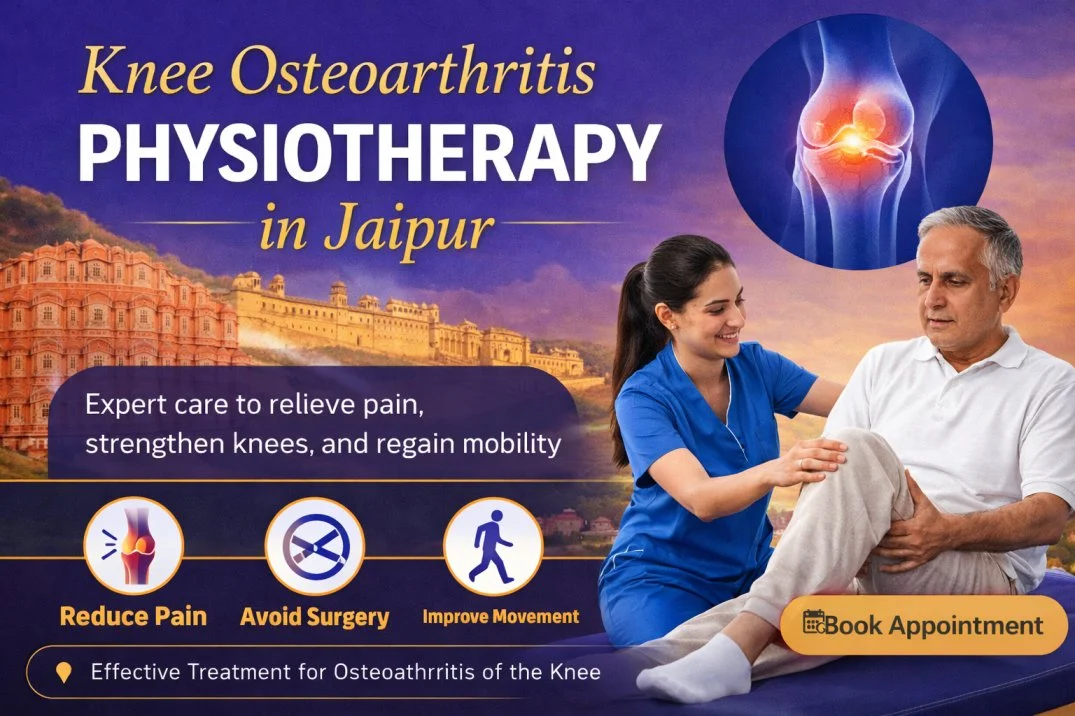
Knee pain is something a lot of people in Jaipur just… live with. They take a painkiller, rest for a day or two, and get back to their routine. And for a while, that works. But if you have started noticing that the pain keeps coming back — or that your knees feel stiff every single morning, or that climbing the stairs has quietly become something you dread — it is worth paying attention.
These are not just signs of “getting older.” In many cases, they are early signs of knee osteoarthritis.
In India, osteoarthritis is the most frequent joint disease, affecting anywhere between 22% to 39% of the general population. For women above 65, that number is closer to 45%. And in a city like Jaipur — where daily life often involves sitting cross-legged on the floor, long hours of walking, and carrying weight — the knees take a lot of stress over the years.
The thing is, knee osteoarthritis is very much manageable. Many patients avoid surgery entirely with the right physiotherapy. At Jagriti Physiotherapy in Shyam Nagar, Sodala, we treat knee OA patients regularly — and this guide covers everything you need to understand about the condition, from what it actually is to how physiotherapy helps.
What is Knee Osteoarthritis?
Simply put, knee osteoarthritis is a condition where the cartilage inside your knee joint slowly breaks down over time.
Cartilage is the smooth, cushioning tissue that covers the ends of your bones where they meet inside a joint. It lets your knee bend and straighten without friction — almost like a shock absorber. When that cartilage thins out or wears away, bones begin rubbing against each other. That is when the pain, swelling, and stiffness start.
The body often tries to compensate by forming extra bone at the edges of the joint — these are called osteophytes or bone spurs. They do not really help, and they can actually make things feel worse.
Osteoarthritis knee is not the same as rheumatoid arthritis. Rheumatoid is an autoimmune disease where the immune system attacks the joint. Osteoarthritis is more mechanical — it is about years of load, wear, and gradual breakdown. It tends to develop slowly, which is actually one of the reasons people miss it early on.
The knee is the most commonly affected joint in OA, both in India and globally. And while age is the biggest risk factor, it is far from the only one.
Also read: Complete Guide to Knee Pain & Physiotherapy in Jaipur
Causes and Risk Factors of Knee Osteoarthritis
There is rarely a single cause. Knee osteoarthritis usually develops because of a combination of things working together over time.
- Age is the most common factor, plain and simple. Most people with knee OA are over 45, and the risk keeps rising after that.
- Gender matters too. Women are significantly more prone to developing osteoarthritis knee — especially after menopause, when hormonal changes reduce protection for joint tissues.
- Body weight is a big one, particularly in urban Jaipur. Every extra kilogram of body weight puts roughly four times that force on your knees when you walk. So even modest weight gain over years adds up to a lot of extra stress on the joint.
- Old injuries – a ligament tear you had years ago, a bad fall, even a fracture near the knee — all of these can alter the way the joint moves and speed up cartilage wear, sometimes decades later.
- Lifestyle habits play a role too. Sitting on the floor for long hours, squatting repeatedly, climbing lots of stairs daily — these put repeated stress on specific parts of the knee joint. So does doing very little exercise, which weakens the muscles that support the knee.
- Occupation and family history also contribute. People in physically demanding jobs or those with a parent who had severe knee OA face a higher baseline risk.
Knowing your risk factors helps, because many of them — weight, activity levels, habits — are things that can actually be changed.
Symptoms of Knee Osteoarthritis
The tricky thing about knee osteoarthritis symptoms is that they tend to sneak up quietly. Most people do not wake up one day with sudden, severe pain. It builds up over months — sometimes years.
Here is what to watch for:
- Pain during or after movement. Stairs are usually the first thing people notice. Pain that starts during activity and settles with rest is a classic early sign. Later on, it can be present even when you are not moving.
- Morning stiffness. The knee feels tight and takes a little while to loosen up after getting out of bed. With OA, this usually lasts less than 30 minutes. Longer stiffness may point to a different condition.
- Swelling. A puffy, warm feeling around the knee — especially after a long walk or a busy day. It tends to come and go in the early stages.
- Cracking or grating. That sound or feeling when you bend your knee? Medically called crepitus. It happens because the cartilage surfaces have become rough and uneven.
- Difficulty bending fully. Sitting cross-legged, squatting, or getting up from a low surface becomes harder. For many Jaipur patients this is one of the first things that affects daily life.
- Knee giving way. Some people feel their knee buckle occasionally — this happens because the supporting muscles have weakened and the joint has lost stability.
If you are ticking more than two or three of these, do not wait. Earlier treatment always means better results.
Grade 1 — Minor
Very early changes. Tiny bone spurs may be forming but cartilage is mostly intact. Most people at this stage have little or no pain. Often spotted by chance on an X-ray taken for something else.
Grade 2 — Mild
The joint space is beginning to narrow slightly. Bone spurs are more visible. You might notice pain after longer walks or occasional morning stiffness. Knee Physiotherapy at this stage is extremely effective — and can genuinely slow down or halt progression.
Grade 3 — Moderate
This is where most patients we see in Jaipur fall, unfortunately. Cartilage loss is significant, joint space is clearly narrowed, and pain is more frequent — during activity and sometimes at rest. Swelling and stiffness are common. Physiotherapy still plays a very strong role here, though it takes more time and consistency.
Grade 4 — Severe
Cartilage is largely or completely gone. Bones are in direct contact. Pain can be constant and severe. Function is significantly limited. At this stage, a knee replacement may be discussed — though even here, physiotherapy is used to prepare the body before surgery and is essential for recovery after it.
Can Physiotherapy Actually Help Knee Osteoarthritis?
This is the question almost every patient asks when they first come in. And we always give the same honest answer.
Physiotherapy cannot grow back cartilage that has already worn away. There is no treatment that can do that right now — physiotherapy or otherwise. So if you are hoping for a complete reversal, that is not realistic.
But here is what physiotherapy for knee osteoarthritis genuinely does deliver: significant pain reduction, better joint mobility, stronger supporting muscles, improved walking and daily function — and for many patients, a genuine delay or complete avoidance of surgery.
International medical guidelines consistently list physiotherapy as the first-line treatment for all symptomatic knee osteoarthritis. Not painkillers. Not injections. Physiotherapy. A combination of supervised exercise, manual therapy, and patient education has the strongest evidence base of any non-surgical approach.
The aim of physiotherapy management of knee osteoarthritis is to make the joint as well-supported and functional as possible — so that even with some cartilage loss, you can move, walk, and live with minimal pain.
Physiotherapy Treatment for Knee Osteoarthritis at Jagriti Physiotherapy, Jaipur
Every patient who comes to us gets an individual assessment before we start anything. A 58-year-old woman with Grade 2 OA and a 70-year-old man with Grade 3 bilateral OA need completely different plans — same condition, very different approach.
Here is broadly how we approach physiotherapy treatment for knee osteoarthritis:
Manual Therapy and Joint Mobilisation
Hands-on treatment forms an important part of early management. We use gentle mobilisation techniques to reduce joint stiffness, improve range of movement, and ease pain. Soft tissue release of the muscles around the knee — the quads, hamstrings, IT band, and calf — is often done alongside this. A lot of patients feel noticeable relief after just a couple of sessions of manual therapy, which helps them engage with the exercise part of treatment more comfortably.
Strengthening Exercises for Osteoarthritis Knee
This is really the core of long-term management. Weak quadriceps muscles are one of the main reasons knee OA pain gets worse over time — when the muscles cannot share the load, the damaged joint takes all of it.
Our physiotherapy exercises for knee osteoarthritis focus on building strength in the quadriceps, hamstrings, hip muscles, and calf. The knee strengthening exercises are carefully graded — progressive enough to build real muscle strength, but not so demanding that they flare up the joint. Most patients are surprised at how much better they feel once muscle strength improves, even before any structural change happens.
Electrotherapy for Pain Management
In the early stages or during flare-ups, pain can make it hard for patients to exercise. We use ultrasound therapy, TENS, and interferential current therapy to manage pain and reduce swelling so that patients can participate in exercise therapy more effectively. These are not permanent solutions on their own — but they are very useful in helping patients through the painful initial phase.
Gait Correction and Posture Work
Many patients with knee OA unconsciously limp or shift their weight to protect the painful knee. Over time this creates new problems — in the other knee, the hip, or the lower back. We work on correcting walking patterns and posture as part of the overall programme.
Home Exercise Programme
Sessions at the clinic are important. But what you do between sessions matters just as much. We teach every patient a home exercise plan — practical, equipment-free exercises they can do daily to maintain and build on the progress made in clinic.
Knee OA Physiotherapy vs Knee Replacement Surgery
Surgery is not automatically the next step after a knee OA diagnosis. Not even for moderate cases.
Physiotherapy is always the recommended first approach before surgical options are considered. For Grade 1, 2, and many Grade 3 patients, a well-designed physiotherapy programme is often enough to manage symptoms and avoid surgery altogether. Even for Grade 4, surgery outcomes are significantly better for patients who have gone through physiotherapy first — both before and after the procedure.
If you have been told you may need a knee replacement, it is absolutely worth having a physiotherapy assessment first. We will give you an honest picture of what conservative management can realistically achieve for your specific situation.
Online Physiotherapy for Knee Osteoarthritis — Consult From Home
Getting to the clinic regularly is not always possible — especially for patients dealing with significant pain, limited mobility, or a busy schedule. That is exactly why Jagriti Physiotherapy offers online consultations for knee osteoarthritis patients across Jaipur and elsewhere.
Through a video call, Dr. Deepesh Nainani will assess your symptoms, review your reports, and build a home-based physiotherapy programme for you. Follow-up sessions track your progress and adjust the plan as you improve. For early-stage OA patients especially, online physiotherapy is a genuinely effective option.
FAQs — Knee Osteoarthritis Physiotherapy
1. What is knee osteoarthritis?
Ans: Knee osteoarthritis is a degenerative condition where the cartilage inside the knee joint wears down over time. It causes pain, stiffness, swelling, and reduced movement. It is the most common joint disease in India, particularly in people above 45.
2. What are the early signs of knee osteoarthritis?
Ans: Early signs include pain after activity (especially stairs), brief morning stiffness, occasional swelling around the knee, and a faint cracking sensation when bending. These symptoms are easy to dismiss early on — which is why many people come for treatment later than they should.
3. What are the stages of knee osteoarthritis?
Ans: Knee OA is graded 1 to 4 on the Kellgren-Lawrence scale. Grade 1 is minor, Grade 2 is mild, Grade 3 is moderate, and Grade 4 is severe. Most patients in Jaipur present at Grade 2 or 3.
4. Can knee osteoarthritis be cured permanently?
Ans: Cartilage loss cannot be reversed. But physiotherapy can significantly reduce pain, restore function, and slow progression — allowing most patients to live an active, normal life. Many patients at Grades 1–3 avoid surgery entirely with proper treatment.
5. Is physiotherapy effective for knee osteoarthritis?
Ans: Yes — and it is not just effective, it is recommended as the first treatment option before anything else. Supervised exercise combined with manual therapy has the strongest evidence of any non-surgical treatment for knee OA.
6. What exercises are best for knee osteoarthritis?
Ans: Quadriceps strengthening, straight leg raises, hamstring stretches, seated knee extensions, and low-impact walking are among the most commonly recommended. The right exercises depend on your stage and current strength — always have a physiotherapist guide you rather than following a generic routine.
7. Can knee osteoarthritis get worse without treatment?
Ans: Yes. Muscles weaken, joint load increases, and cartilage continues to wear. Ignoring early symptoms usually means presenting at a more advanced stage later — where treatment takes longer and outcomes are less predictable.
8. How many physiotherapy sessions are needed for knee osteoarthritis?
Ans: Mild cases may show clear improvement within 8–12 sessions. Moderate cases usually need a longer programme — often 3 to 6 months, with a home exercise routine to maintain gains. There is no fixed number, as every patient progresses differently.
9. Is walking good or bad for knee osteoarthritis?
Ans: Generally good — in the right amount. Short, regular walks on flat surfaces help maintain joint health and muscle strength. Long walks on uneven terrain or pushing through sharp pain can aggravate things. Your physiotherapist will guide you on what is appropriate for your stage.
10. When should I consider knee replacement instead of physiotherapy?
Ans: Knee replacement is typically considered when OA is at Grade 4, pain is severe and constant, daily function is significantly affected, and physiotherapy has been tried consistently without enough relief. It is not a decision to rush. Getting a physiotherapy assessment before committing to surgery is always worthwhile.
About the Author

Dr Deepesh nainani
Dr. Deepesh Nainani (PT) is a leading physiotherapist in Jaipur, offering expert, patient-focused care. He leads Jagriti Physiotherapy with a skilled team across multiple specialties. Known for his achievements and modern treatment approach, he ensures effective recovery and long-term results, making him a trusted choice for physiotherapy in Jaipur.
Get Quote Now

