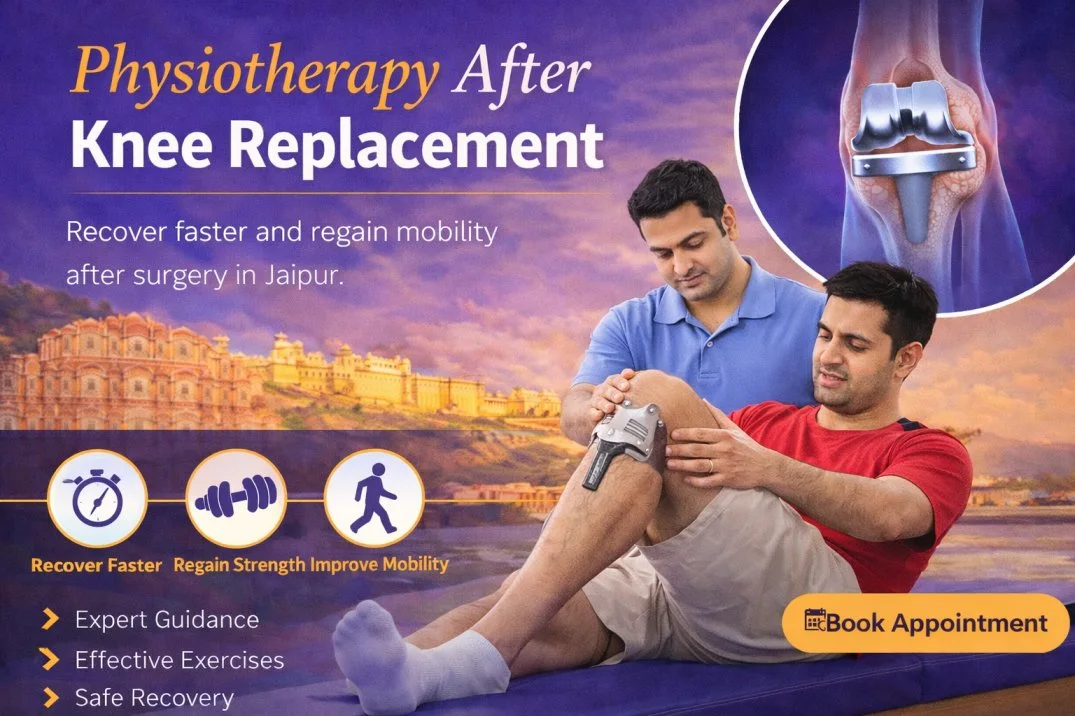
Knee replacement surgery is a big decision. For most patients in Jaipur who go through with it — usually after years of worsening knee pain, failed medications, and a quality of life that has slowly shrunk — the surgery itself is actually the easier part. The harder part, and the part that determines how well you actually recover, is what comes after.
Physiotherapy after knee replacement is not optional. It is not something you do “if you feel up to it.” It is the very thing that converts a successful surgery into a functional knee — one that lets you walk without pain, climb stairs, sit on the floor, and get back to daily life in Jaipur.
Surgery replaces the damaged joint. Physiotherapy restores the movement, strength, and confidence to actually use it.
At Jagriti Physiotherapy in Shyam Nagar, Sodala, we provide specialized knee physiotherapy after surgery services and work with post-knee replacement patients at every stage of recovery — from the first few days after discharge right through to full rehabilitation months later. This guide explains what to expect, when to expect it, and exactly what physiotherapy does at each stage.
Why Physiotherapy After Knee Replacement is Essential
There is a common misunderstanding that once the damaged joint is replaced, the knee will “just work.” In reality, the muscles around the knee — particularly the quadriceps — are significantly weakened by the surgery itself. The trauma to surrounding soft tissue, the temporary immobility, and the pain in the early days all lead to rapid muscle wasting. Without a structured rehabilitation programme, these muscles do not recover on their own at the rate needed.
Research consistently shows that patients who follow proper physiotherapy after total knee replacement have better pain outcomes, greater range of motion, stronger walking ability, and higher satisfaction scores than those who do not. Some studies suggest that quadriceps strength imbalances between the operated and non-operated leg can persist for a year or longer after surgery in patients who do not follow a structured rehabilitation programme.
Beyond muscles, orthopedic physiotherapy after knee replacement also addresses swelling management, scar tissue formation, gait correction, stair climbing, balance, and the psychological confidence to start trusting the new knee again. That last one matters more than most people expect — many patients are almost afraid to put weight through the knee, and that reluctance itself slows recovery significantly.
Also Read: Complete Guide To Knee Pain & Physiotherapy Treatment in Jaipur
Total vs Partial Knee Replacement — Does Rehab Differ?
Yes, somewhat — though the principles are largely the same.
Total Knee Replacement (TKR)
Involves replacing all three compartments of the knee joint. It is recommended when arthritis or damage is widespread across the entire joint — which is the more common situation in older patients. Recovery from a TKR is longer and more intensive. Full rehabilitation typically takes 3 to 6 months, with some patients — particularly those who were less active before surgery — taking up to 12 months to reach their full potential.
Partial Knee Replacement (PKR)
Also called unicompartmental replacement, replaces only the damaged part of the knee while leaving the healthy portions intact. Because less bone and tissue is disturbed, recovery tends to be faster — many patients return to daily activities within 4 to 6 weeks, with full recovery often achieved within 2 to 3 months. The knee also tends to feel more natural after a PKR because more of the original joint structure is preserved.
In terms of physiotherapy after partial knee replacement, the exercises and phases are similar to TKR — but the progression tends to be quicker, with patients typically tolerating more activity earlier. The goals are the same: restore range of motion, rebuild muscle strength, correct walking pattern, and return to daily function safely.
Week-by-Week Physiotherapy Recovery Timeline
Recovery after knee replacement does not follow a perfectly linear path — some days feel like big progress, others feel like you have gone backwards. That is completely normal. But here is a general picture of what to expect at each stage.
Week 1–2 — Early Stage (Hospital and Home)
The first two weeks are about settling the knee and getting it moving in the safest way possible. Pain and swelling are expected and managed with medication, icing, and elevation. Most patients are discharged from hospital within 2 to 4 days and begin physiotherapy almost immediately — either in hospital or at home.
Key exercises at this stage are deceptively simple but incredibly important. Ankle pumps (moving the foot up and down repeatedly) help blood circulation and reduce the risk of deep vein thrombosis. Quadriceps sets — tightening the thigh muscle while the leg is straight — begin reactivating the quad, which has switched off significantly around the surgery. Straight leg raises come next, helping rebuild early quadriceps strength without bending the knee under load.
Getting in and out of bed safely, walking short distances with a walker, and managing stairs with support are also worked on during this phase. Everything is gentle, supervised, and carefully paced.
Week 3–6 — Intermediate Stage
This is where physiotherapy really gets going. Swelling should be gradually reducing, and the knee should be bending more each week. A key milestone for most patients is achieving 90 degrees of knee flexion — the ability to bend the knee to a right angle — by around 4 to 6 weeks. This is important for sitting comfortably in chairs, getting in and out of cars, and managing daily activities.
Exercises become more progressive — mini squats, sit-to-stand practice from a chair, step-ups, stationary cycling, and resistance band work. Walking distances increase. Many patients transition from a walker to a cane during this phase, and by 6 weeks some are walking without any support indoors.
Gait training is a significant focus here. The walking pattern after knee replacement often needs careful correction — patients tend to walk with a stiff-legged gait, compensating for pain and weakness. Left uncorrected, this puts extra load on the hip and lower back and slows recovery of the operated knee as well.
Week 7–12 — Advanced Recovery
By this stage most patients are moving much more confidently. The focus of physiotherapy recovery shifts from basic function to building real strength, endurance, and stability.
Exercises now include more demanding movements — lunges, lateral steps, balance work on one leg, stair climbing without a handrail, and longer walks. Functional exercises that mimic real-life demands are introduced — getting up from a low chair or sofa, walking on uneven surfaces, managing inclines.
Patients are encouraged to gradually return to household activities, social outings, and light physical activity. Driving is typically permitted again around 6 weeks for automatic cars, slightly longer for manual, but this should be confirmed with the operating surgeon.
Most range of motion is regained within the first 3 months, though strength — particularly in the quadriceps — can take 6 to 12 months to fully recover.
Key Exercises After Knee Replacement
Patients often ask — what are the two critical exercises after knee replacement? If we had to narrow it down, they would be these:
1. Quadriceps strengthening
The quad is the dominant muscle of the knee. It controls how you lower yourself into a chair, how you climb stairs, how you walk without limping. After knee replacement, the quad is significantly weakened and does not recover without targeted work. Quadriceps sets, straight leg raises, and progressive loaded exercises are the backbone of the entire rehabilitation programme.
2. Knee flexion (bending) exercises
Regaining full range of motion — especially the ability to fully bend the knee — is time-sensitive. Scar tissue begins forming within weeks of surgery, and if the knee is not stretched regularly and progressively in the early months, stiffness can become a long-term problem that is very difficult to reverse. Heel slides, assisted knee bends, and cycling are the core tools for restoring flexion.
Beyond these two, other important exercises after knee replacement include hamstring strengthening, hip abductor work, balance and proprioception training, and gait-specific drills. The programme is built around your individual progress — not a one-size-fits-all routine.
Warning Signs to Watch During Recovery
Recovery is rarely completely smooth. Some discomfort and swelling is entirely normal, especially in the first few weeks. But there are specific warning signs that should prompt you to contact your surgeon or physiotherapist immediately.
Excessive or sudden increase in swelling
Especially if it comes with increased warmth or redness around the knee. This can indicate infection or deep vein thrombosis (DVT).
Calf pain or swelling
Pain, tightness or swelling in the calf can be a sign of DVT and needs urgent medical attention. Do not ignore this.
Fever above 38°C
A temperature after surgery that persists or spikes can be a sign of infection and must be reported to your surgeon promptly.
Wound discharge or opening
Any fluid leaking from the incision, or the wound edges separating, needs to be reviewed by your medical team.
Severe pain that is worsening rather than improving
Some pain in the early weeks is expected. Pain that is getting significantly worse after the initial few weeks, rather than gradually improving, is not normal and should be assessed.
Inability to straighten or bend the knee beyond very limited range by 6 weeks
Some stiffness is normal early on, but if you are making very little progress with range of motion despite consistent physiotherapy, it is worth discussing with your team.
Being alert to these signs does not mean something will go wrong — the vast majority of knee replacements in India go very well. But catching complications early always leads to better outcomes.
How Many Physiotherapy Sessions Are Needed After Knee Replacement?
There is no single answer to this — it genuinely depends on the individual. But here is a realistic picture.
In the first 6 weeks, most patients benefit from physiotherapy sessions 2 to 3 times per week, alongside daily home exercises. After 6 weeks, as function improves, sessions typically reduce to once or twice a week while home exercise intensity increases.
By 3 months, many patients are largely managing their rehabilitation independently with periodic check-ins. Between 3 to 6 months — and in some cases up to 12 months — continued strengthening and functional training is recommended, even if formal clinic sessions become less frequent.
The total number of sessions varies widely. A straightforward recovery might involve 20 to 30 sessions over 3 to 4 months. Patients who are older, had very limited function before surgery, or who develop stiffness or other complications may need significantly more.
The most important thing is consistency. How long you should do exercises after knee replacement is essentially: until the knee is as strong and functional as it can be — which for most people is at least 6 months, and ideally continuing low-level maintenance exercise long term.
Online Physiotherapy After Knee Replacement
Not every patient in Jaipur can get to a clinic multiple times a week — especially in the early weeks of recovery when mobility is limited. Jagriti Physiotherapy offers online video consultations for patients recovering from knee replacement surgery.
Through a video call, Dr. Deepesh Nainani can review your current recovery progress, guide you through your home exercise programme, assess your range of motion and walking pattern, and adjust the rehabilitation plan as you improve. For patients who live far from Sodala, or who are in the later stages of recovery and primarily exercising at home, online physiotherapy is a practical and effective option.
If you are in the Jaipur area and able to visit the clinic, in-person sessions are always recommended in the early weeks — hands-on physiotherapy for swelling management, manual techniques, and supervised exercise make a real difference in early recovery. Online consultations complement this, particularly as you progress into the intermediate and advanced stages.
FAQs — Knee Replacement Rehabilitation
1. When should I start physiotherapy after knee replacement surgery?
Ans: Ideally within the first 24 to 48 hours after surgery — even while you are still in hospital. Early movement reduces the risk of complications like DVT, prevents excessive stiffness, and begins the process of reactivating the muscles. Do not wait until you are “feeling better” to start — early, gentle physiotherapy is safe and beneficial.
2. What are the two most critical exercises after knee replacement?
Ans: Quadriceps strengthening and knee flexion (bending) exercises are the two most important. Quad strength is essential for walking, stair climbing, and all functional movements. Knee flexion work prevents scar tissue from causing long-term stiffness. Both must be started early and maintained consistently throughout recovery.
3. How long does physiotherapy recovery take after knee replacement?
Ans: Most patients regain basic daily function within 6 to 12 weeks. Full strength and functional recovery — including return to more active daily life — typically takes 3 to 6 months. Some patients, particularly after total knee replacement, continue to see improvements up to 12 months post-surgery.
4. How long should I do exercises after knee replacement?
Ans: At a structured rehabilitation level, for at least 6 months. But maintaining some level of regular strengthening and mobility exercise long-term is genuinely beneficial — not just for the replaced knee but for overall joint health. Think of it less as a treatment that ends and more as a lifestyle adjustment.
5. What is the difference between total and partial knee replacement rehabilitation?
Ans: The principles are the same, but the pace differs. Partial knee replacement patients generally recover faster — returning to daily activities within 4 to 6 weeks and completing rehabilitation in 2 to 3 months. Total knee replacement rehabilitation typically takes 3 to 6 months, with strength continuing to improve up to 12 months.
6. Is physiotherapy painful after knee replacement?
Ans: Some discomfort during exercises — particularly knee bending — is normal and expected, especially in the first few weeks. The rule of thumb is that mild to moderate pain during exercises is acceptable, but sharp or severe pain, or pain that is significantly worse for hours after exercising, is a signal to ease off and discuss with your physiotherapist.
7. Can I do physiotherapy at home after knee replacement?
Ans: Yes — home exercises are a crucial part of recovery. Your physiotherapist will provide a programme to follow between clinic sessions. That said, in-person physiotherapy in the early weeks adds significant value through hands-on techniques, supervised exercise, and real-time correction of movement patterns that cannot be fully replicated at home.
8. What happens if I skip physiotherapy after knee replacement?
Ans: Muscle weakness, joint stiffness, a poor walking pattern, and long-term functional limitations are all consistently associated with inadequate rehabilitation after knee replacement. In some cases, severe stiffness can develop — a condition called arthrofibrosis — which is very difficult to reverse and may require further procedures. Physiotherapy is not optional.
9. When can I climb stairs after knee replacement?
Ans: Most patients are introduced to stair climbing with support in Week 1 to 2 of recovery. By 6 weeks, most can manage stairs with a handrail reasonably well. Confident, unsupported stair climbing typically comes between 2 to 4 months, depending on individual progress.
10. Are there activities to avoid after knee replacement?
Ans: High-impact activities — running, jumping, heavy contact sports — are generally discouraged long-term to protect the implant. Low-impact activities like walking, swimming, cycling, and yoga are generally encouraged. For Jaipur patients, prolonged sitting cross-legged on the floor and deep squatting positions may need to be modified permanently, depending on the implant type. Your surgeon and physiotherapist will guide you on what is safe for your specific situation.
About the Author

Dr Deepesh nainani
Dr. Deepesh Nainani (PT) is a leading physiotherapist in Jaipur, offering expert, patient-focused care. He leads Jagriti Physiotherapy with a skilled team across multiple specialties. Known for his achievements and modern treatment approach, he ensures effective recovery and long-term results, making him a trusted choice for physiotherapy in Jaipur.
Get Quote Now

